Advanced Clinician Scientist Program for Comprehensive Neuroscience (PROMISE)
The BMFTR-funded program PROMISE is a structured qualification program for Advanced Clinician Scientists that fosters long-term and sustainable career trajectories. It supports physicians who, alongside clinical duties, engage in basic, translational or clinical research within the interdisciplinary field of neuroscience.
PROMISE will bring competitively selected Advanced Clinician Scientist (ACS) candidates into permanent leadership positions and, drawing on input from ACS, implement a novel concept for integrative neuroscience and patient care. PROMISE will integrate clinical research with insights on disease mechanisms (vertical integration) and across clinical disciplines (horizontal integration). The program builds on strong links with basic research as represented by the participating institutions, the Excellence cluster SyNergy and various collaborative research centers (CRCs).
PROMISE fellows pursue independent research programs with a protected overall split of 50-50% for clinical and research time, have an” ACS group leader” status with secured lab and office space, receive priority access to unique infrastructure, technology, and resources for disease-oriented research, and can rotate into collaborating research institutions. PROMISE fellows benefit from strategic support measures and an individualized qualification and mentoring program that is geared to the competencies of established researchers. PROMISE is monitored and fellows undergo an interim and tenure review before moving to permanent positions. LMU Medicine commits to create new professorships and additional alternative leadership positions offering a variety of career options for ACS.
Thematic focus
Neuroscience and related clinical disciplines such as cardiology, oncology, ophthalmology, and (neuro)radiology
Program duration
6 years
Program objective
Clinical-scientific management position
Funding agency
Bundesministerium für Forschung, Technologie und Raumfahrt (BMFTR)
Funding scope
€135,000 per year (including own research leave of absence, normally 50%)
Protected research time
50% (flexible during the program duration, can be divided into full-time and/or part-time)
Supervision Committee
Individually assigned team of mentors
ScientificEnvironment
multiple opportunities for collaboration and access to cutting-edge infrastructure
Qualifications and career prospects
tailored qualification, mentoring, and long-term career prospects within the department/institute
Why an ACS-Program for Comprehensive Neuroscience?
The impressive development of diagnostic and therapeutic options for neurological diseases (e.g., stroke, multiple sclerosis, and Parkinson’s disease) and emergence of novel approaches for conditions that have traditionally been considered inaccessible to treatment such as Alzheimer’s disease, Huntington’s disease, or muscular dystrophy poses new challenges for organising research and patient care across traditional clinical disciplines. For instance, the reduction in stroke mortality rates has shifted attention to the psychiatric long-term consequences of stroke (dementia, depression).
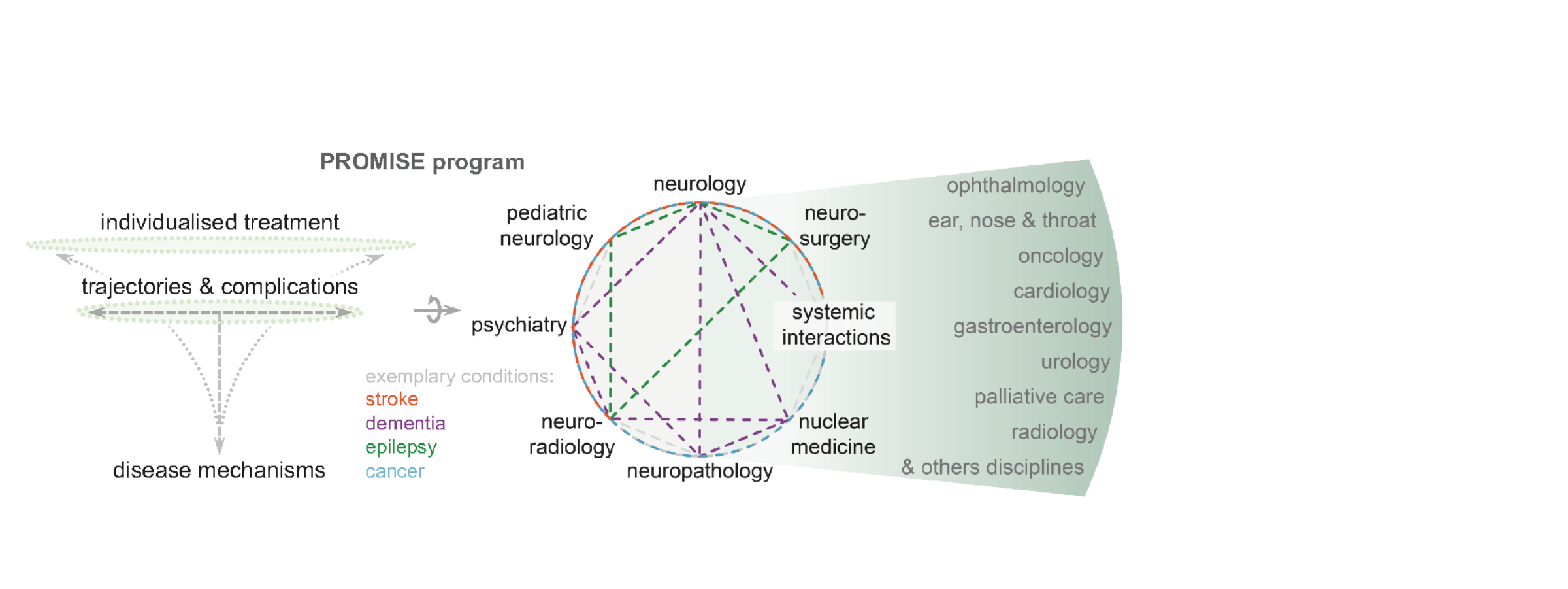
Also, the development of novel anti-amyloid treatments for Alzheimer’s disease illustrates the need to invest in early diagnostics (nuclear and laboratory medicine; neuroradiology) and prepare services both in neurology and psychiatry for the requests from patients to come. The range and complexity of unresolved questions in clinical and translational neuroscience including ethical aspects requires a strong contribution of qualified clinician scientists and collaboration across different disciplines. Comprehensive Neuroscience is as a multidisciplinary approach that emphasizes the need to integrate clinical research with insights on disease mechanisms (vertical integration) as well as across clinical disciplines (horizontal integration) with the aim to better detect, prevent and treat neurological conditions with their multiple trajectories, complications, and comorbidities (examples for selected conditions in Figure below).
Topical Focus, integration into clinical care and future perspective
The program will have a focus on comprehensive neuroscience, foster new types of collaborations between disciplines (exemplified for stroke, epilepsy, dementia) and integrate knowledge from different fields to improve risk prediction, prevention, and treatment. The program will be open to multiple disciplines and serve as a nucleus for future expansion of the ACS program to other research foci at LMU’s Faculty of Medicine.
Outstanding institutions for neuroscience and patient care provide PROMISE fellows with a broad range of opportunities extending across multiple clinical disciplines and covering basic, translational and clinical aspects.
Core clinical departments at LMU Hospital
Neurology
Psychiatry & Psychotherapy
Pediatrics
Child and Adolescent Psychiatry
Neurosurgery
Neuroradiology
Nuclear Medicine
Neuropathology
and other disciplines as e.g. cardiology, oncology
Dedicated translational research institutes
Institute for Stroke and Dementia Research (ISD)
Institute of Clinical Neuroimmunology (INIM)
Friedrich Baur Institute for Neuromuscular Diseases (FBI)
Institute of Psychiatric Phenomics and Genomics (IPPG)
Alzheimer Treatment and Research Center (ATRC)
German Center for Vertigo and Balance Disorders (DSGZ)
These institutions closely collaborate with major research institutions in the Munich area that have a strong focus on Neuroscience including the LMUBiomedical Center, the three Max-Planck Institutes (Psychiatry, Biological Intelligence, Biochemistry), and the Helmholtz Zentrum Munich (HMGU).
Cooperation with research networks/institutes
Munich Cluster for Systems Neurology (SyNergy)
CRC 1744 “Compartmentalized Cellular Networks in Neurovascular Diseases”
CRC-TR 274 “Checkpoints of Central Nervous System Recovery”
FOR 2879 “Immunostroke”
CRC-TR 167 “Development, function and potential of myeloid cells in the CNS (NeuroMac)”
German Center of Neurodegenerative Disease (DZNE)
German Center for Mental Health (DZPG)
German Center for Child and Adolescence Health (DZKJ)
The BMFTR promotes, beyond the individual Advanced Clinician Scientist programmes, the creation of a shared platform EMPOWER-ACS. The platform organizes regular network meetings to foster network-building and knowledge exchange among ACS fellows and to increase visibility. The central coordination office based in Würzburg collaborates with ACS and their program coordinators to plan joint events, such as annual network meetings, to promote ongoing cooperation and dialogue.
Bonn: ACCENT – Advanced Clinician Scientist Program Bonn Dresden: CAMINO – Career Advancement in MultIdimeNsional tumOr targeting Erlangen: iIMMUNE_ACS – Interfaces in Immunomedicine Essen: UMEA2 – Promoting Excellence in Translational Medicine Frankfurt: INITIALISE – Innovations in Infection Medicine Freiburg: IMMediate – Immune-Mediated Diseases Hamburg: iSTAR – integrative Advanced Clinician Scientists Targeting Inflammatory and Infectious Diseases Würzburg: INTERACT – Interfaces in Translational Research
LMU-network "MCSP"
The PROMISE-fellows are part of the Medical & Clinician Scientist Program (MCSP). The MCSP is a structured funding program of the LMU Medical Faculty to support young scientists at the LMU University Hospital who are pursuing an academic career and the further development of university medicine.
The MCSP provides a uniform framework for promoting scientists (e.g., protected research time, qualification, career development through mentoring and coaching, quality assurance measures) and creates a local interdisciplinary network for them through various exchange formats (regular meetings, annual retreat).
Board-certified physician in a specialty relevant to the topical focus of PROMISE - or - all formal prerequisites for registration for the board certification exam are fulfilled
Position - or - offer of employment as physician at LMU Hospital
Outstanding scientific track record with a clear independent research profile in a neuroscience-related field
Successful acquisition of third-party funding
Strong motivation to pursue a long-term career as a clinician scientist
Commitment to Open Science, research transparency and good scientific practice
Team player with strong interpersonal skills and willingness to take on leadership and management responsibilities
Incomplete applications or applications not submitted by the deadline cannot be considered. In principle, additional third-party funding is welcome, although double funding must be ruled out.
Submission of the application by 15.05.2026 as a single PDF-file by email to the PROMISE Coordination Office.
If you have any questions, please contact the PROMISE Coordination Office.
Female physicians are explicitly encouraged to apply.
Positions will be open to both internal and external candidates.
The Selection of PROMISE-Fellows involves a three-stage selection process:
Selection Committee: the selection committee will generate an initial ranking of applicants and pass the top rated applications to external reviewers.
External Reviewer: each application will be evaluated by external reviewers based on scientific achievements, the project proposal and clinical qualifications. The top-rated applicants will be selected.
Selection Committee: On-site review and interview for the final selection of the best candidates.